China's first distributed electric-driven flying car - Southeast University Kunpeng No.1 - was developed and unveiled by a research team at Southeast University in East China's Jiangsu Province. It features full steering and all-wheel drive capabilities, according to a press release sent to the Global Times by Southeast University on Thursday.
The vehicle features a configuration with four coaxial rotors. Yin Guodong, the project leader, also a professor from School of Mechanical Engineering of Southeast University noted that the research aims to pioneer new modes of transportation for the future and contribute more efforts to the low-altitude economy.
Unlike traditional electric vertical take-off and landing aircraft, the Southeast University Kunpeng No.1 is designed as an integrated land-air vehicle, which combines the ground mobility as well as the movement capabilities of aerial vehicles, according to the university.
"This is China's first flying car based on distributed electric drive technology, using a car as its primary carrier, rather than relying on drone technology, enabling smooth transitions between driving on the ground and flying in the air," said Yin.
With a maximum take-off weight of 500 kilograms, the vehicle has a flight endurance of at least 20 minutes and reaches a maximum flying height of more than 300 meters. In ground mode, it can achieve a top speed of 60 kilometers per hour, according to the university.
Currently, it relies on a high-capacity power battery. The research team is also working on more research, expected to extend flight durations to over two hours in the next-generation flying cars, according to the university.
The flying car represents a multidisciplinary integration and innovation, spanning mechanical, vehicle, electrical, and control sciences, among other disciplines.
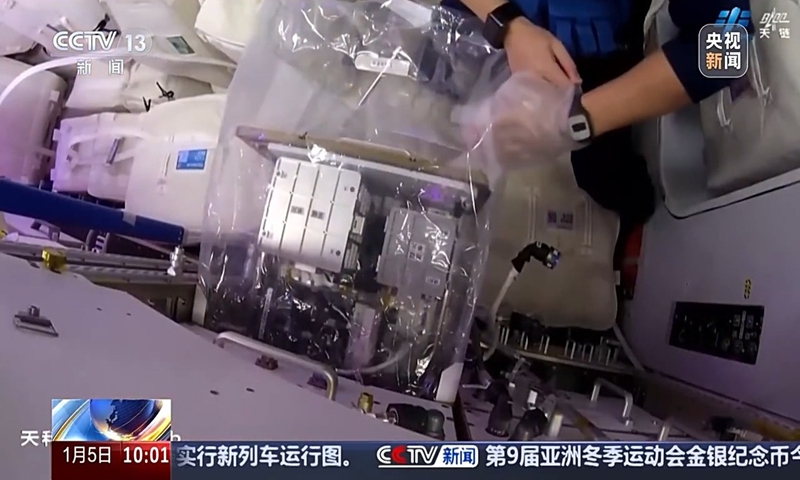
The Shenzhou-19 crew has made smooth progress in the space life sciences and human research project focused on the space hypomagnetic effects on drosophila and their molecular mechanisms. The "fruit fly family" is thriving, with the potential to become the first species to reproduce for three generations aboard China's space station, according to the China Central Television on Sunday.
Last week, the crew successfully completed tasks such as fruit fly collection, clearing of cultivation boxes, and sample organization. Earlier, with the successful launch of the Long March-7 Y9 carrier rocket, China sent fruit flies to the space station for the first time to conduct scientific experiments.
According to the Xinhua News Agency, the fruit fly is one of the model species frequently used in genetic experiments. It is small, measuring only 3 to 4 millimeter in length, and has a short life cycle with fast reproduction capabilities, enabling it to produce a large number of offspring within a short period, according to Zhang Wei, a researcher involved in the selection of in-orbit scientific experiments, at the Technology and Engineering Center for Space Utilization under the Chinese Academy of Sciences.
"The genes of fruit flies share many similarities with those of humans, so the study can help with understanding human genetic diseases and provide insights into how humans adapt to space environments," Zhang said in a recent interview.
On the space station, fruit flies from the Institute of Biophysics of the Chinese Academy of Sciences (CAS) were divided into two groups. One group lives in the microgravity environment of space, while the other is placed in a magnetic shielding device, simultaneously subjected to the combined effects of microgravity and a hypomagnetic field, China Science Daily reported on December 16.
Upon arrival in space, the fruit flies went through a fascinating adaptation period. In the microgravity environment, a simple flap of their wings would send them shooting forward like bullets. When they stopped flapping, they would drift uncontrollably, attempting to kick their legs to change direction.
Fortunately, these small creatures quickly adapted to their new environment. Researchers at CAS, led by Professor Li Yan, jokingly referred to these terrestrial flying experts as having learned to "swim like frogs" in space, according to the China Science Daily report.
A video transmitted from space on November 19 showed a tiny fruit fly emerging from its pupa and curiously observing its unfamiliar surroundings. This fruit fly, affectionately called the "first baby fruit fly born in space" by the research team, marks China's first successful fruit fly reproduction in space.
On Earth, fruit flies can reproduce a new generation in 12 to 15 days. With an expected on-orbit experiment duration of 36 days, they are likely to become the first species to achieve "three generations under one roof" aboard China's space station.
After the fruit flies return to Earth, Li's team will further analyze their behavior and gene expression during their time in space. The goal is to uncover the effects of microgravity and hypomagnetic fields on animal behavior and the underlying neural and molecular mechanisms, said in the China Science Daily report.
Li told the China Science Daily that one could imagine future generations establishing bases or even permanent homes on the Moon, where gravity is only one-sixth that of Earth and the magnetic field is extremely weak. She wondered whether animals would be able to reproduce across generations on the Moon, noting that fruit flies are pioneers in humanity's exploration of space.
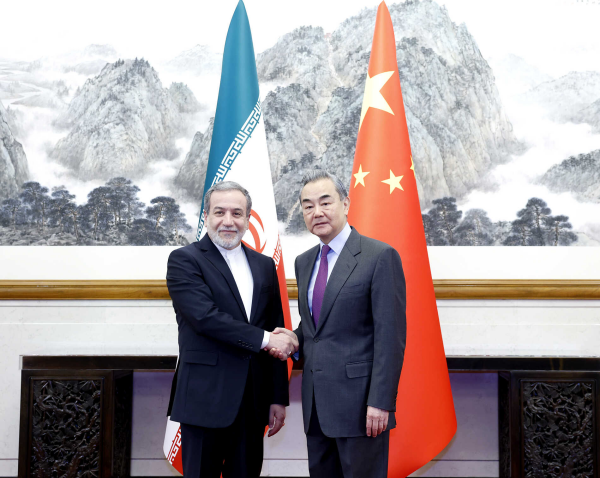
Chinese Foreign Minister Wang Yi met with Iranian Foreign Minister Seyyed Abbas Araghchi on Saturday in Beijing, during which Wang said that enhancing coordination and cooperation between China and Iran not only benefits the peoples of both countries, but will also contribute to promoting regional and global peace, stability, and development, according to a statement released by China’s Ministry of Foreign Affairs on Saturday.
Araghchi began a two-day visit to China from Friday at the invitation of the Chinese side, the Chinese Foreign Ministry announced on Friday.
During the meeting, Wang, also a member of the Political Bureau of the Communist Party of China Central Committee, said that China and Iran established a comprehensive strategic partnership and are important members of the Global South. The relationship between the two countries has a long history, rooted in the strong and deep traditional friendship between their peoples, mutual trust and support since the establishment of diplomatic relations more than half a century ago, and their shared pursuit of independence, self-improvement, and national rejuvenation, which has withstood the tests of changing international circumstances.
Enhancing coordination and cooperation between China and Iran benefits both nations and contributes to regional and global peace, stability, and development, said Wang.
Wang emphasized that both countries should continue to support each other on issues related to their core interests, steadily advance practical cooperation, and enhance multilateral collaboration. Both sides should closely coordinate within the Shanghai Cooperation Organization (SCO), jointly promote the Shanghai Spirit, facilitate more cooperative projects, and build closer SCO community with shared future.
Both sides should work together to enhance greater BRICS cooperation, cultivate new areas of cooperation, further strengthen BRICS, and better safeguard the common interests of the Global South, Wang said.
Wang also emphasized that, in the face of today's world of instability and uncertainty, we must remain resolute, firmly believe that the historical trend of world multipolarity, economic globalization, and cultural diversity is unstoppable, and that unilateral hegemony will ultimately lose support.
We must steadfastly focus on our own development, steadily advance national development strategies, and inject greater stability into the world. We must strengthen unity and cooperation, oppose hegemonic and bullying actions, and jointly advocate and practice true multilateralism, working to build a more just and reasonable global governance system, said Wang.
Araghchi stressed that developing and strengthening the comprehensive strategic partnership between Iran and China is a priority in Iran's foreign policy. Iran adheres to the one-China principle and firmly supports China’s legitimate positions on core issues, including Xinjiang, Xizang, and human rights.
Iran looks forward to closer high-level exchanges with China, deepening mutually beneficial cooperation, and strengthening communication and collaboration within multilateral frameworks like the United Nations, SCO, and BRICS to safeguard shared interests, said Araghchi.
The two sides agreed to further advance the implementation of the China-Iran comprehensive cooperation plan, strengthening exchanges of governance experience in political diplomacy, legislative institutions, law enforcement, judicial matters, and economic and trade fields. They will also enhance cooperation and exchanges in areas such as youth, education, sports, technology, culture, tourism, environmental protection, public health, and media, as well as deepen interactions at the civil, local, and sister-city levels to make unremitting efforts to promote the development of China-Iran relations, according to the foreign ministry’s statement.
The two sides also had an in-depth exchange of views on the current situation in the Middle East. Both agreed that the Middle East belongs to the people of the Middle East; it should not be a battleground for great power rivalry, nor a victim of geopolitical struggles and conflicts by external powers.
The fate of Middle East countries should be in the hands of their own people. The international community should genuinely respect the sovereignty, security, stability, unity, and territorial integrity of Middle East countries, respect their legitimate concerns, respect the choice independently made by Middle East people, and respect their historical and cultural traditions. The international community should play a constructive role in promoting peace and stability in the Middle East, according to the statement.
The path to peace and stability in the Middle East lies in adhering to political solutions without external interference and in compliance with international law. Both sides support the continued reconciliation momentum between Iran and Saudi Arabia after the restoration of diplomatic ties and encourage regional countries to maintain dialogue and consultations, said the statement.
The two sides agreed that resolving the Palestinian issue requires respecting and restoring the legitimate rights of the Palestinian people and ending the occupation. The immediate priority is to implement a ceasefire, withdraw military forces, and provide urgent humanitarian assistance. They called for the effective and full implementation of the ceasefire deal and emphasized respect for Syria's sovereignty, independence, and territorial integrity, urging an integrated approach to Syria's counter-terrorism, reconciliation, and humanitarian processes.
The two sides also exchanged views on the Iranian nuclear issue.
Wang emphasized that China has always advocated for addressing the Iranian nuclear issue through political dialogue and upholding the Joint Comprehensive Plan of Action. All relevant parties should play a constructive role in restoring dialogue and negotiations. China opposes the frequent use of sanctions and pressure and firmly supports Iran in safeguarding its legitimate rights and interests.
Araghchi appreciated China’s important role in facilitating and maintaining the Joint Comprehensive Plan of Action and expressed Iran's willingness to maintain close communication with China.
Chinese President Xi Jinping on Friday hailed the enormous transformation that has taken place in Macao since its return to the motherland in 1999.
Xi, also general secretary of the Communist Party of China Central Committee and chairman of the Central Military Commission, said the practice of "one country, two systems" with Macao characteristics has been a tremendous success.
How can influencers contribute to bringing China and ASEAN countries closer together As part of the ASEAN-China Year of People-to-People Exchanges, influencers from 10 ASEAN countries with a total of nearly 100 million followers traveled to Sanya, Lingshui and Qionghai, among other places, in South China's Hainan Province, over the last week to discover China's development from this picturesque island. They shared their personal stories and experiences in China through videos they made, fostering friendly exchanges and solidarity between China and ASEAN.
From interviews with several influencers from ASEAN, reporters from the Global Times learned about their efforts to promote exchanges between China and ASEAN countries and the benefits of China-ASEAN cooperation.
Becoming ambassadors of goodwill
Shi Zhongjun, secretary-general of the ASEAN-China Centre, said at the conference that just as a lush canopy needs strong roots, the friendship between ASEAN and China cannot go far without the solid support of both peoples.
Influencers are the best standing testimony to the current blossoming of ASEAN-China relations, and they can become ambassadors of goodwill to present the real story of win-win cooperation between ASEAN and China to the international community, while gathering positive energy for regional development to convey to the world the confidence of ASEAN and China in cooperation and development in a truthful, accurate and comprehensive manner, Shi said.
The first stop of the influencers' trip was the Haikou Fullsing Internet Industrial Park in the Hainan Free Trade Port (FTP), where they gained a detailed understanding of the development prospects, key industry directions, tax incentives, as well as the scale and layout of the Hainan FTP.
Hainan FTP enjoys favorable policies, a great environment and a highly potential tourism consumption market that deserves to be known by more people, Shantay, an influencer from Singapore, told the Global Times. "Some of my followers are businessmen, and numerous companies in my country are keen on investing in China. I believe that if I share videos on social media, it will be highly appealing to them," Shantay said.
Influencers also explored several traditional attractions in Hainan, experienced Chinese craftsmanship and enjoyed local delicacies.
They strolled on the Qilou Old Street in Haikou, South China's Hainan Province, where rows of buildings encompass a blend of architectural styles. The influencers were in good spirits, snapping pictures while walking, and even dancing joyfully on the street.
"I feel it's a pity that many Malaysians don't know such a wonderful destination featuring Southeast Asian style in China. I can't wait to share this journey with my followers through my camera," Malaysian influencer Rosshanaz told the Global Times, adding that people from ASEAN countries such as Malaysia, Indonesia and Singapore will resonate strongly with this attraction.
In the Betel Nut Valley, or Binglang Valley, a large park dedicated to Hainan Li and Miao minority culture, the influencers from ASEAN countries watched a Li and Mao ethnic culture-themed performance with large-scale and original ecological features and applauded the performers for their wonderful performance. They also experienced the rhythm of the Bamboo Dance of the Li ethnic group and enjoyed the delicious cuisine of the Li ethnic group.
The profound cultural heritage and diverse interactive experiences offered the influencers a vibrant and dynamic source of creative inspiration.
Rosshanaz said that she is pleasantly surprised to see how well China's traditional culture is preserved and how effectively its history is passed down. China and Malaysia share many similarities in traditions and customs. Therefore, she hopes that the people of Malaysia can strengthen communication with China, which will help in the preservation of Malaysian culture and promote cultural exchange between the two nations, Rosshanaz added.
Shantay said she is always longing to try traditional Chinese dresses, and this experience in the Betel Nut Valley gave her the perfect opportunity. "My followers are predominantly females, and they are all very interested in beautiful clothing and fashion. I believe that once I post my video, many people will come to experience traditional attire of Li ethnic group," Shantay told the Global Times.
"I have always believed that food is the quickest way to foster connections between people of different nationalities and an effective means to bridge distances. I often share my food-tasting stories on social media, so I am confident that the unique cuisine of the Li ethnic group will become a new trend," Muangphum Harnsiripetch, known as Han Bing in China, a Thai influencer who previously studied at Nanjing University, told the Global Times.
The Best of Both Sides
Chinese Foreign Minister Wang Yi, also a member of the Political Bureau of the Communist Party of China Central Committee, noted in July's ASEAN-China Foreign Ministers' Meeting that China and ASEAN, who are friendly neighbors and close partners, have seen the building of a China-ASEAN community with a shared future being steady and fruitful, benefiting 2 billion people on the two sides while greatly promoting common development, according to the Xinhua News Agency.
Han said that for him, the greatest benefit of China-ASEAN cooperation is the visa-free policy between China and Thailand. The visa waiver has made it easier for people to travel between the two countries, said Han, which has also boosted personal exchanges between both countries.
For her part, Bella, an internet influencer from Vietnam, said she has benefited considerably from the cooperation between China and Vietnam in the field of education. "Studying in China will bring a lot of opportunities, it is the cooperation between countries that makes educational exchanges possible."
Like what Chinese Foreign Ministry spokesperson Hua Chunying said in a video address to the conference, influencers are the ones who are best at telling engaging stories on the internet and social media. They have a unique and irreplaceable role in promoting mutual understanding among people of different countries. In this very era we live in, we expect more influencers to share more stories about the friendly exchanges between ordinary people of China and ASEAN countries, delivering more positive energy to consolidate and promote people-to-people exchanges between the two sides.
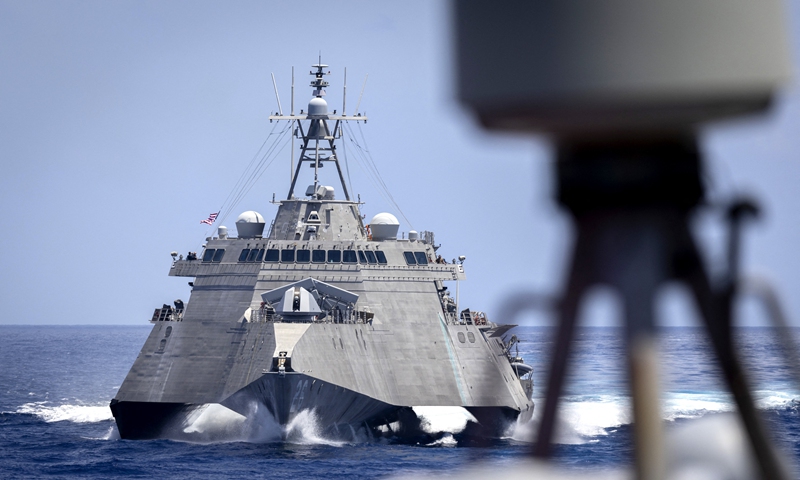
The US Navy Secretary Carlos Del Toro on Wednesday revealed the US Navy's plans to upgrade the weaponry of its Littoral Combat Ship (LCS). These upgrades include equipping it with the MK-70 Payload Delivery System (PDS), with Del Toro expressing confidence that the LCS will play a crucial role in the future. However, a Chinese military expert told Global Times that whether this concept can play an important role remains to be seen.
According to the USNI News, the US Navy is planning a lethality upgrade on both classes of the LCS that includes the ability to launch larger missiles like the SM-6, Secretary of the Navy Carlos Del Toro said on Wednesday.
"Today, the Littoral Combat Ship is equipped with the Naval Strike Missile (NSM), a long-range precision strike weapon. Eventually, many will receive the Mk 70 Payload Delivery System with vertical launch system technology," Del Toro said as he announced the service's efforts to upgun the Littoral Combat Ship with Naval Strike Missiles and containerized Mk.41 vertical launching systems at the Naval Institute's Defense Forum Washington.
On October 24, 2023, the US Navy's Independence-variant LCS, the USS Savannah (LCS 28), conducted a live-fire demonstration on October 24 in the Eastern Pacific Ocean utilizing a containerized launching system that fired an SM-6 missile at a designated target.
The USNI News report said that the US Navy plans to install the two systems on Freedom and Independence Littoral Combat Ships under the Over-the-Horizon (OTH) Weapons System upgrade, which looks to deliver enhanced maritime strike capabilities to the class. Compared to the NSM, a low-observable missile that can strike targets more than 100 miles away, the containerized four-cell MK-41 vertical launch system can support the multi-role SM-6 and the intermediate ranged Tomahawk Land Attack Missile.
Del Toro claimed the MK-70 PDS would give the service "tremendous firepower and even more technical advantage over our adversaries."
Lockheed Martin also presented concepts that integrate NSM and up to three Mk 70 PDS onto the Freedom-class at Surface Navy Association 2024, USNI News reported.
Del Toro expressed confidence in the combat potential of the upgraded LCS. However, whether it can truly deliver "a strong comeback" with enhanced lethality remains uncertain. Chinese military expert Zhang Junshe told Global Times on Thursday that the LCS was originally introduced by the US Navy in the early 21st century to meet its operational requirements for a "from the sea to the land" strategy, focusing on operations in littoral areas.
The LCS features modular mission execution capabilities, enabling it to perform mine-clearing and anti-submarine tasks in challenging hydrographic and meteorological conditions. However, it suffers from significant limitations in air defense and anti-ship capabilities, Zhang noted.
Zhang pointed out that the LCS was deployed to locations such as Singapore in the Far East, but during this period, it experienced frequent malfunctions. The modular mission execution performed poorly, and the ships faced issues like hull leaks and unstable electrical systems, often leaving them stranded. As a result, the LCS has been criticized within the US Navy.
"With the growing far seas combat capabilities of some the US competitors, the US Navy's strategy has shifted back to the traditional goal of sea control, rendering the LCS ill-suited for the latest combat doctrines. This led to plans to retire the LCS from active service," Zhang added.
Subsequently, under the OTH weapons upgrade program, the US Navy sought to deploy air defense and anti-ship missiles on the LCS to address its inherent weaknesses. Zhang explained that the SM-6 missile can perform both air defense and maritime strike missions, while the Tomahawk cruise missile, with a range exceeding 2,000 kilometers, can strike deep into maritime targets, enhancing air defense and maritime strike capabilities.
However, Zhang argued, "This concept may be 'ambitious in design but constrained in reality.'
With a displacement of only about 3,000 tons—smaller than most frigates—whether the LCS can accommodate the MK-70 PDS and its associated missile payload while maintaining stability remains a challenge, Zhang said, noting that "the feasibility of effectively launching so many missiles is also in question. Based on the US descriptions, this is a classic example of 'overloading a small cart with a big load,' making it difficult to achieve sufficient combat capability. This warrants further observation."
Notably, NSMs have already been installed on forward-deployed Independence-class LCSs in the "Indo-Pacific" region. "We have every intent to deploy them aggressively. Everywhere around the globe. And the Persian Gulf, obviously with the mine-sweeping capability, and everywhere else its needed. Particularly in the Pacific with these added capabilities," said Del Toro.
According to the USNI News, the US Navy plans to field a fleet of 25 Littoral Combat Ships - 15 Independence-class ships equipped with a mine countermeasures mission package that will eventually replace the legacy Avenger-class MCM ships based in Bahrain and Japan and 10 Freedom-class ships that will field a variation of the surface warfare package that will include Naval Strike Missile and Hellfire AGM-114L Longbow strike missiles in addition to the MK-70 launchers.
In response, Zhang highlighted that this reflects the US military's operational priorities in "the Middle East, Asia-Pacific, and Europe." Del Toro's mention of the Persian Gulf and Pacific underscores the strategic focus on small watercraft maneuverability in the mine-laden waters of the Persian Gulf, where the LCS's small size and flexibility are advantageous.
Meanwhile, in the Pacific, the US Navy's strategy revolves around countering "competitors" in littoral regions, aiming to strike both surface ships and land-based targets. This deployment strategy demonstrates the Navy's evolving strategic doctrine, Zhang said.
Former Chinese national football team head coach Li Tie was sentenced to 20 years in prison in a first-instance verdict on Friday for a number of charges including offering and accepting bribes.
The verdict was made by the Intermediate People's Court of Xianning, Central China's Hubei Province.
From 2019 to 2021, Li, taking advantage of his position as the head coach of the Chinese men's national football team, accepted bribes totaling over 50.89 million yuan ($7.04 million), the Beijing Daily reported, citing revelations from the courts.
On the same day, Du Zhaocai, former deputy director of the General Administration of Sport of China and former Party secretary of the Chinese Football Association, was sentenced to 14 years in prison and fined 4 million yuan for accepting bribes.
The Wuhan Intermediate People's Court in Central China's Hubei Province publicly sentenced Du in a first-instance trial for accepting bribes worth over 43 million yuan, according to the CCTV news.
Du used his position to seek improper benefits for football clubs in matters such as relocating home stadiums and player transfers, severely disrupting the fair competition order and industry environment in the football field. He also sought job promotions and adjustments for others, which warranted a heavier sentence.
After Li and Du's sentencing, Chinese Football Association (CFA) Vice President Yang Xu on Friday reaffirmed the zero-tolerance stance on corruption in football at a media briefing on the domestic football leagues. He highlighted the CFA's efforts to combat illegal practices during the 2024 season.
"We will continue to adopt a high-pressure approach to combat match-fixing, gambling, and other illegal activities," Yang said.
Yang also emphasized the importance of tightening admission standards for financial management to ensure financial stability for clubs and safeguard the rights of players, clubs, and youth training institutions.
"We must further tighten the league admission standards … Efforts to address unpaid wages and overdue payments will protect the legitimate rights of players, clubs, and training institutions," Yang was quoted as saying by the Xinhua News Agency.