Overseas Gen Zers explore Guangming Cinema's barrier-free movies for the visually impaired, learn how digitalization empowers social projects
In China's cinematic landscape, a groundbreaking revolution is quietly taking place at the Guangming Cinema, which embraced cutting-edge digital methods to immerse visually impaired people in the magic of storytelling through the medium of film.

"Welcome to the Guangming (Light) Cinema. Here we convey film through voice and perceive art through sound. Today you will experience the movie Ne Zha," a narrator explained to a group of young opinion leaders from 15 countries.

As they settled into their assigned movie theater seats, the 16 international youth opinion leaders from 15 countries were about to have a unique viewing experience at the Guangming Cinema in China's capital of Beijing. Here, they got to "watch" a movie while blindfolded, to learn what a movie-going experience is like for those living with visual impairment.

They sat in front of a screen, listening carefully to the sounds from the movie. Throughout the movie screening, along with the character voices, film score, and background action sound, those taking part in the sensory experiment also heard the voice of a narrator describing scenes, moves, and visual effects otherwise hard to enjoy without the sense of sight. 

Actually, the movie these overseas young people were "watching" is a barrier-free movie - also named voice-descriptive movie, a product specially adapted for people living with visual impairment - created by a group of volunteers at the Guangming Cinema to allow visually impaired people to enjoy the equal right of walking into a cinema and enjoying a well-rounded movie-going experience like people with sights would have.

The Guangming Cinema Audio-descriptive Movie Making and Promotion Project, a public welfare project established by the Communication University of China (CUC) in Beijing in 2017, aims to create reproducible and transmittable audio-descriptive products to meet the growing spiritual and cultural needs of the visually impaired.

The movie Ne Zha, which deeply moved the audience of young international visitors, is just one of several hundred barrier-free movies that come with complete narration and are re-recorded by volunteers.

Data showed that there are 17.32 million people living with visual impairment in China, and the number of people with dyslexia may be even higher. To meet the cultural and spiritual needs of such a large population posed a great challenge for Chinese society and related government departments in the past.

In the plan for protection and development of disabled people during the 14th Five-Year Plan (2021-25) period, the Chinese government pointed out the necessity of supporting people living with disabilities and enhancing the quality of public services, such as rehabilitation, education, culture, and sports. The creation of a barrier-free environment in China has become an important aspect of promoting the modernization of the national governance system and governance capacity. 

The Guangming Cinema Project is a vivid example of the country's efforts to build a barrier-free environment for the visually impaired. Since its establishment, the project has provided rich inclusive and culturally relevant products for a large number of visually impaired people.

As of May 2023, the Guangming Cinema has produced 520 barrier-free movies and two barrier-free television series, and has carried out public welfare screenings in 31 provinces, municipalities, autonomous regions, and the Macao Special Administrative Region, reaching over 2 million people across the country. 

Arduous but rewarding process

At the Guangming Cinema, a group of volunteers including professors, undergraduates, and postgraduate students, have devoted most of their leisure time participating in activities related to the film project, such as the re-recording of barrier-free movies, coordinating and promoting the screening of such movies, with the desire to help visually impaired people to experience and enjoy the world through cinema.

Xue Hanjie, a junior undergraduate student majoring in radio and television editing at the CUC Television School, told the Global Times that she joined the project in her freshman year and worked as a volunteer in the project's production group.

For Xue and other volunteers with the project, making barrier-free movies is not only about describing the stories in a movie, but also about helping the visually impaired to understand the meaning that the director wanted to convey to audiences. The opening shot, the landscape, the appearance and movements of a character, any and all aspects pertinent to the development of the plot are narrated, to help those who are visually impaired to gain a complete picture of what's happening in the movie.

Sometimes, when there are too many characters and different languages in a film, narrators dub the movie in Chinese and in different voices, so that the visually impaired can fully understand the plot only by listening.

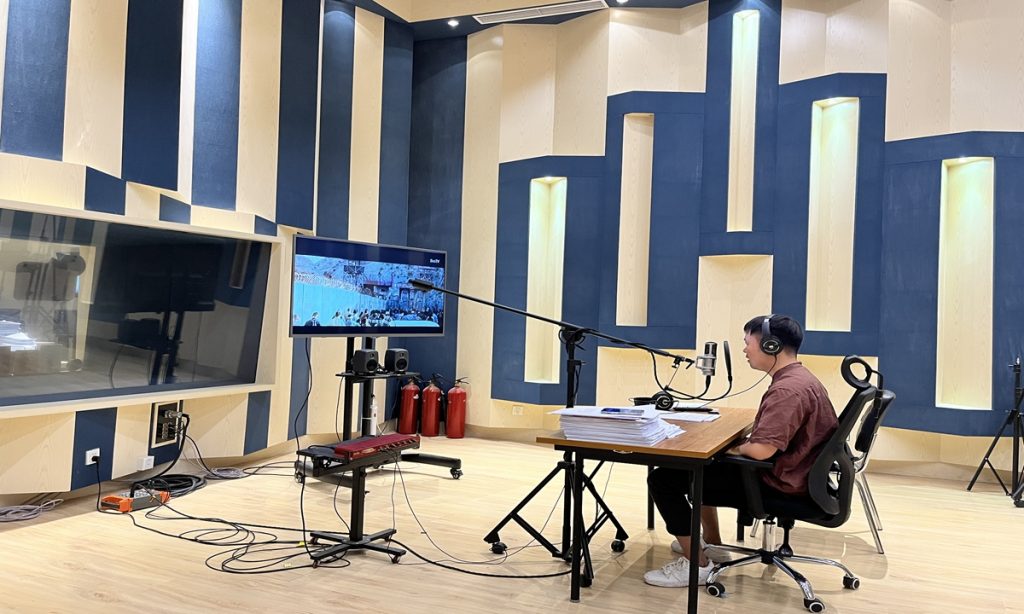
In the dubbing room, volunteer Li Zhixing, a postgraduate student at the CUC, watches the scenes of a movie and actively adjusts his emotions and voice accordingly. Judging from the needs of the role, he sometimes plays the role of a young soldier, and then switches to the voice of an old man. 

In order to control the voice performance of the actors and accurately convey emotions, a seemingly simple sentence has to be repeated and recorded four to five times over.

At the same time, outside the dubbing room, two volunteers at the tuning table align Li's dubbed dialogues and narrations with the appropriate scenes in the movie being worked on. 

Cai Yu, a PhD student from Television School at the CUC, and also a volunteer with the project for about six years, explained that the making of a movie is usually time consuming and detail oriented. "In the beginning, we invite a volunteer to write the narration script. Teachers and other volunteers then review and proofread the script three times, polish the details, and then we start recording in the dubbing room, and go through editing, film encoding, and finally reviewing," Cai elaborated.

On average, narrating and dubbing a 90 to 120 minutes' film usually takes two to three months. A volunteer can usually only make one film over the course of one semester, Cai said.

The professionalism and responsibility of volunteer work left a deep impression on the overseas youth opinion leaders.

"Empathy and understanding were the thoughts that came to my mind when we were exposed to the project and the movie. It was a moving experience since I was able to put myself in blind people's shoes," Jose Carlos Feliciano, deputy director of the Center for China and Asia-Pacific Studies, University of the Pacific, Peru, told the Global Times after having a visually impaired movie-going experience.

Igor Alexander Bello Tasic, founder and CEO of Meta Ventures from Spain, said that when he wore the blindfold and "watched" the movie, he could feel that volunteers were not performing a technical job, but an artistic one.

They were not just trying to create a layer of information, but were narrating the story in a way similar to "Director's cut" - a human layer that connected that media with people who could experience it in its original form, Tasic said.

'Human reality' of volunteers

Due to work experience, Tasic knows some of the technologies related to visual reality and augmented reality, but at the Guangming Cinema, he said that what he felt was a sort of "human reality," a humanization of senses that he has never seen before.

The project has attracted more and more like-minded students, who want to help improve the quality of life of those living with visual impairment in the Chinese society. Cai said that each year, about 100 undergraduates and postgraduate freshmen join the project's volunteer team.

Rida Hameed, a journalist with Pakistan's K21 News, said that visiting the Guangming Cinema was the best moment of her life, giving her a sense of peace and satisfaction that there are people in this world who don't work for money but for the sake of humanity and kindness.

The Guangming Cinema now aims to produce 104 barrier-free films each year. "There are 52 weeks in a year, and we want to ensure that at least two barrier-free movies are provided for the visually impaired every week," Xue told the Global Times.

In the control room, the visitors saw printed movie narration scripts stacked into two 50-centimeter-high piles beside the tuning table. According to preliminary statistics, the number of words written by the volunteers in one year can be as many as 3 million.

"I was able to see the editing process for the voices, and realized that it really takes a lot of time and patience. The project has a long working hour process and requires great commitment (from the volunteers)," said Feliciano to the Global Times.

At the end of the year or during special occasions, the project team integrates the barrier-free movies and saves them in specially-made mobile hard disk drives and U disks, so that these movies can be played on computers even in the remotest villages in China. The team also stores movies in audio recorders with a memory card in it, allowing people with visual impairment to listen to the movies anytime and anywhere.

Pursuing for 'bright' future

In May 2022, the Marrakesh Treaty, which is the first and only human rights treaty that is copyrighted, officially came into effect in China.

The treaty allows authorized entities to produce print formats of cultural works geared toward those living with disabilities without authorization from copyright holders, from Braille books and audiobooks to films and TV shows. Experts noted that it is a practical move that China adopted to expand the country's human rights protection sphere for some 17 million print-disabled people, giving them equal access to culture and education.

Based on the Marrakesh Treaty, the Guangming Cinema has carried out many public warfare activities for people with visual impairment. Since April 2021, the project team has cooperated with the Beijing School for the Blind to screen barrier-free movies for children once a month.

In the Guangming Cinema, a special collection attracted the international visitors' attention and deeply moved them. It was a Braille text written by a little girl from the Beijing School for the Blind to the Guangming Cinema, displayed in a 6-inch red photo frame, on which it reads "Everyone is someone's light, and you are our light."

In order to allow the visually impaired to gain the full movie-viewing experience, the volunteers also chose to screen barrier-free movies in places such as the Chaoyang Theater in Beijing, a highly populated residential area with convenient transportation facilities for visually-impaired people.

"We insist on providing barrier-free movies in theaters and cinemas, because we want to help achieve equal rights for those who are visually-impaired. They deserve an equal right to walk into a cinema and enjoy a movie," said Xue.

Additionally, volunteers from the Guangming Cinema went to remote places in China to carry out public welfare screenings, so that visually impaired people in those areas and people in ethnic minority areas could also enjoy the cultural experience brought by movies. The movies and television series made for people living with disabilities by the project volunteers were also sent out to 2,244 special education schools across China.

As of 2021, there were 2,288 special education schools in China, increased from 1,933 in 2013, according to the Report on the Cause for Persons with Disabilities in China (2023) issued in May, 2023. This means that about 98 percent of special education schools in China have benefited from the project, where students in said schools can enjoy barrier-free movies made.

Feliciano told the Global Times that in Guangming Cinema, he was impressed by how digitization was used to empower philanthropy and social projects in China. "It's very interesting to see how Chinese innovative solutions can be an inspiration to other countries," he said.

He also said that he would share the digital example with his students and write articles about what he had learned on his trip in China, to let more people know about China's practices in the digital sphere.

This is really a noble cause and other countries in the world must learn from how China is taking good care of its people, not only at present but are also trying to make the future better as well, Hameed said.

Beijing, Hebei authorities mobilize all-out effort to safeguard people from impact of flooding

Amid torrential rain, rivers surged, houses collapsed and communications were disrupted... Under the influence of Typhoon Doksuri, heavy rainfall has persisted in Northern China, impacting regions like Beijing, the neighboring Tianjin Municipality and Hebei Province and setting records that haven't been seen in a century. Rescuers are racing against time, fighting to establish a "lifeline" to save lives and property.

From 8 pm on July 29 to 7 am on August 2, extreme heavy rainfall has drenched China's capital city. The highest recorded rainfall was at the Wangjiayuan Reservoir in the Changping district, being a total of 744.8 millimeters over this period, the local meteorological department reported on Wednesday. 

This extreme rainfall has significantly exceeded historical records, ranking it as the highest recorded rainfall in the past 140 years.

In Beijing, multiple areas in Mentougou district in western Beijing faced dangerous situations, while communications were disrupted in 62 villages across seven townships in Fangshan district in southwestern Beijing. 

The water level of the Yongding River, the main waterway in Beijing, surged, while a bridge over the Xiaoqing River located west of Lugou Bridge collapsed. 

In response to the torrential rainstorms and floods that have wreaked havoc in Beijing and its surrounding regions, authorities are mobilizing an all-out effort to safeguard the people from the impact of disasters. Various rescue teams have been working tirelessly to provide assistance.

On Thursday, the Global Times reporters saw People's Armed Police soldiers assist in the relocation of disaster-affected residents in Liulihe township, Fangshan district. 

Fortunately, as water levels gradually recede, rescue operations in Fangshan are nearing completion.

Simultaneously, to alleviate flood control pressure on Beijing and Tianjin, Hebei has activated seven flood water detention areas and relocated 1.2 million residents, according to a report from the Hebei Daily on Wednesday.

Zhuozhou, a city in Hebei Province that neighbors the Fangshan district of Beijing, has seen over 130,000 people affected by the disaster and is still being heavily impacted by flooding. More than 150 civilian rescue teams arrived, and more have been summoned from across the country.

On Thursday, members of the volunteer rescue team, including the Blue Sky Rescue team, helped transfer flood-affected residents and supplies in Huangjiajie village and Mengjiajie village in Matou township, Zhuozhou. Meanwhile, more rescue supplies were arriving at the scene.

Before the arrival of the flood, residents living on low ground had been notified and relocated to safe places, the Global Times learned from local residents.

On Wednesday evening, the Global Times witnessed villagers from Mentougou district departing from Yanchi township and moving downhill along the railway to safer areas. 

Meanwhile, soldiers of the People's Liberation Army rescued villagers from remote mountainous villages, especially elderly people with mobility issues, using military trucks, transporting them to temporary shelters.

During the evacuation process, an interim command center was established in the Mentougou district to coordinate various rescue efforts. Simultaneously, emergency, firefighting, medical, and other rescue and support forces were deployed. 

Relief points were set up to provide drinking water, food, medicine, and other supplies to ensure the safety and basic needs of the evacuees.

British: British Council showcases education cooperation at CACIE 2023

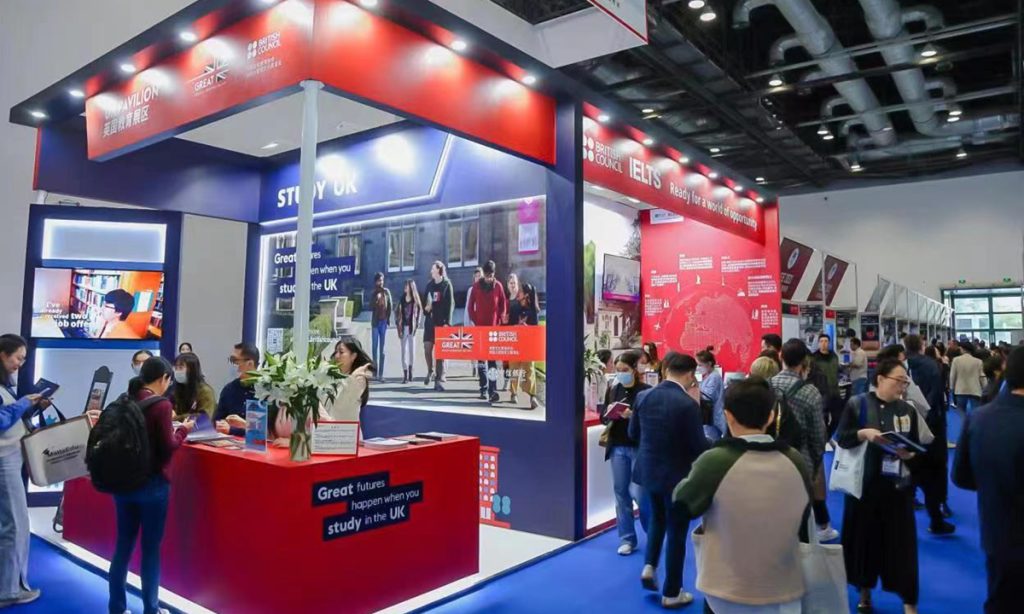
From October 26 to 28, the British Council participated in the 24th China Annual Conference for International Education and Expo (CACIE 2023) as a CACIE Honorary Partner, and hosted two sub-forums on higher education: "From Study to Work: Global Talent Mobility and Development" and "English Teaching and Assessment to Enhance International Understanding Education in Secondary Schools." 

The former focused on the current trends and challenges of talent cultivation and mobility in the context of international education, while the latter addressed the hot topic of international understanding education in the K12 sector. 

"Through the two forums, we shared our insights on the mobility and development of Chinese students abroad, and introduced our comprehensive assessment solutions and ecosystem value chain from study to work, represented by the British Council's IELTS test. We were also honored to invite our partners, top universities and enterprises from home and abroad, to share their best practices and explore how to better support the lifelong growth and development of international education in China," said You Zhuoran, director of examinations at the British Council China. 

Xi’s reply letter inspires momentum in strong ‘Chinese hearts’ creation for domestic aircrafts

Editor's Note:

Chinese people believe that letters are as valuable as gold. For thousands of years, letters, across mountains and oceans, have been delivering writers' sentiments and conveyed friendship and expectations.

Xi Jinping, general secretary of the Communist Party of China (CPC) Central Committee and Chinese president, has managed to find time to reply to some letters from different parts of society and the world despite his busy work schedule.

Through his letters, Xi has corresponded with international friends from all walks of life on numerous occasions, part of a series of excellent stories of China's international exchanges in the new era. The letters have also added vivid color to the diplomacy between China and other countries.

The Global Times traced and contacted some of the recipients of Xi's letters, to hear the inspiring stories behind the letters and their communication with the president.

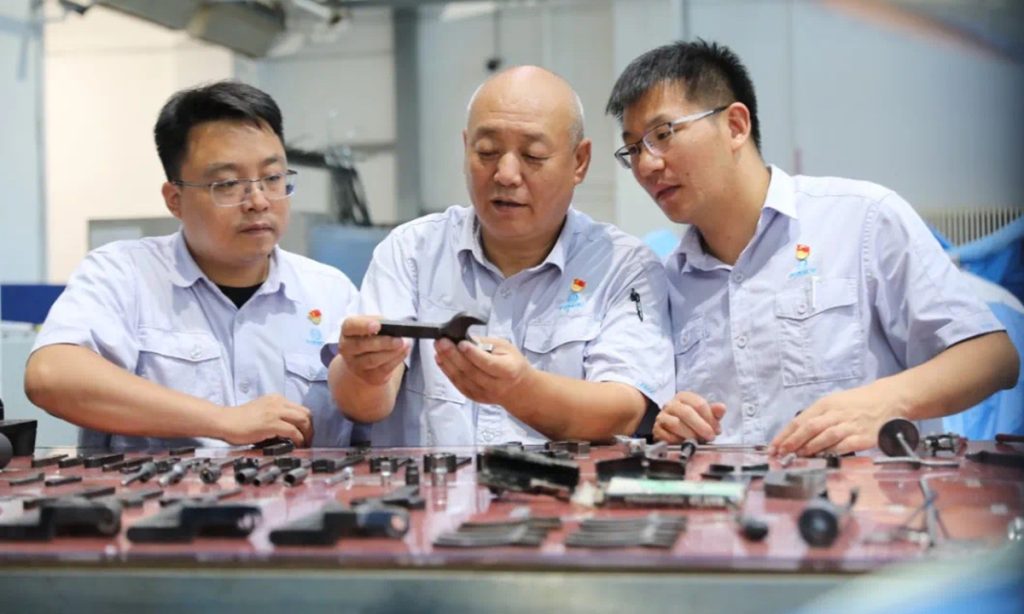
In this installment, Global Times reporters spoke with technicians from the Aero Engine Corporation of China (AECC) Shenyang Liming Aero-Engine Co, Ltd to learn about their stories of devoting themselves to the research and development of China's domestic aero engines and how Xi encouraged them to inherit and carry forward the spirit of a great country's craftspeople, along with a thorough review of how China gradually created its own aero engines.

"A workman must first sharpen his tools if he wants to do his work well," is a Chinese saying that emphasizes not only the importance of tools of a craft, but indicates the vital role of the craftsman who creates the tools.

"Your work is important and honorable," Chinese President Xi Jinping, who is also general secretary of the Communist Party of China (CPC) Central Committee and chairman of the Central Military Commission, told technicians at the Li Zhiqiang Class in Aero Engine Corporation of China (AECC) Shenyang Liming Aero-Engine Co Ltd, while Xi visited the corporation in 2013 to review its work in developing and producing aero engines.

A decade later, in a letter to the class on September 1, Xi spokes highly of the contribution of technicians in the research and development process of China's aero engines.

Xi emphasized that aero engines are a vital national asset and an important reflection of the country's scientific and technological strength and innovation capabilities. "I hope you will remember your mission and responsibilities, firmly uphold the aspiration of serving the aviation industry, promote the spirit of model workers and craftsmen, strive to make more technological breakthroughs, accelerate the pace of independent research and development of aviation engines, and enable Chinese aircraft to have a stronger 'Chinese heart,'" Xi said in the letter.

Until recently, aero engines had been a shortcoming in China's aircraft development, but that impression changed drastically when the Chinese People's Liberation Army (PLA) Air Force's most advanced stealth fighter jet, the J-20, made its first public appearance equipped with a pair of domestically developed engines in 2021, replacing imported engines used in the past.

Aero jeweler
The aero engine is deemed the "crown jewel" of modern industry. An aero engine is composed of tens of thousands of components of different shapes and materials. The circuit of the engine is like blood vessels around the human body, which requires a very high degree of precision to assemble and allows no room for error.

Technicians from the Li Zhiqiang Class, named after national model worker and national technical expert Li Zhiqiang, are exactly the people who are responsible for assembling aero engines and gas turbines.

"At that time, the president said our work 'is important and honorable.' He also said that the turbine vanes and blades are as valuable as diamonds. We always recall such acknowledgement and encouragement and use them as fuel to keep striving forward," said Li Zhiqiang, recalling Xi's visit a decade ago.

In a letter to Xi, Li and seven other technicians reported achievements made in strengthening technological innovation and promoting independent research and development in the aero industry over the last decade, expressing their determination to accelerate the pace of independent research and development of aero engines and build a strong aviation nation.

As the initiator among a total of eight technicians from the class who wrote the letter, Li told the Global Times that Xi's reply letter showed "extreme recognition, was encouraging, and inspirational" to the team. He shared the letter's contents to all 62 members of the team. "We must keep in mind his care, trust, and ardent expectations, firmly follow the new path of independent innovation and development of aero engines, and ensure that China's domestically made aircraft will use a stronger 'Chinese heart' in the future," he said.

One of Li's primary work principles is to "never give up before all problems are solved." In the last decade, Li, together with his colleagues, made use of various methods, including 3D simulation, to elaborately lay out processing plans for different products in accordance with their characteristics, efficiently increasing assembly quality and reducing the production period.

A typical example of the class implementing the principle is the aero engine accessory case. In the past, the case needed to be held together by several people when trying to install it in the belly of the engine, which is difficult and inefficient. This problem greatly bothered Wen Shangzhi, the current leader of the class. To solve it, Wen and his team members made use of their spare time to discuss, search materials, and conduct experiments, finally creating a new method, which obtained certification from experts and effectively improved installation efficiency.

It is in this way that the Li Zhiqiang Class found solutions and overcame obstacles one by one over the last decade, by inventing new methods, new technologies, and new tools. In total, the team solved 52 technical problems in scientific research and assembly, independently developed 312 tools and obtained more than 50 invention patents, the Global Times learned from the corporation.

When two J-20 fighter jets appeared the sky on the hot and humid opening day of the Airshow China 2021, on September 29 in Zhuhai, South China's Guangdong Province, not many spectators fully understood what they had just witnessed.

The two jets started their flight performance with a low tandem flyby above the air show site. Then, one of the aircrafts drastically pulled up and soared into the sky, while the other pulled left and performed a tight spiral maneuver before vanishing into the clouds, in a display of the aircraft's outstanding power and maneuverability.

Immediately after the flight performance, Senior Colonel Li Jikuan, commander of the J-20s' flight performance, announced at a press conference at the air show that it was the J-20's first public performance after being fitted with domestically built engines.

Experts told the Global Times that the domestically built engines provide more powerful thrust that helps the J-20 in super-maneuverability and supersonic cruise, while the engines' serrated nozzles can improve the aircraft's stealth capability.

Another important aspect of converting to use domestically built engines is that it enables mass production of aircrafts, since there are no import restrictions, experts said.

The J-20 is not the only aircraft to use domestically developed engines. Also at the Airshow China 2021, Tang Changhong, chief designer of the Y-20 large transport plane, announced that the Y-20 would be equipped with two types of domestically developed engines. After being equipped with these engines, the Y-20's capabilities have received a boost, Tang said.

Compared with imported engines, the Chinese engines could boost the Y-20's range, endurance, and cargo capacity by providing more powerful thrust and using less fuel, while also allowing the plane to take off and land on shorter runways, analysts said.

Another key member of the "20 aircraft family," the Z-20 utility helicopter, also uses domestically developed engines.

The developers of the Z-20 told the Global Times in October 2019 that the domestically developed engines are powerful enough to enable the helicopter to fly in low-oxygen plateau regions.

Observers noted that the primary battle aircrafts owned by the PLA had converted to domestically developed engines as of this year, but that does not mean China's continued efforts in aero engine development have reached their goal.

Toward stronger future

In the 2022 edition of the Airshow China, AECC showcased five variants of the Taihang series turbofan engines, which are used by different aircraft.

The Taihang engine has received continued improvements and upgrades, and its performance, reliability, safety, stealth capability, power extraction, environmental adaptability, endurance, and thrust vectoring - among other factors - have all received technical boosts.

This is expected to comprehensively enhance the aircraft's survivability and combat capabilities, and has realized the complete independent support of domestically developed engines.

One of the five Taihang engines on display has a 2D thrust vectoring control nozzle, which attracted the attention of visitors.

Li Gang, the pilot of the J-20 stealth fighter jet's first flight, said in a media interview that he would like to see the J-20 eventually be upgraded with engines with 2D thrust vectoring nozzles.

Thrust vectoring control can greatly enhance the maneuverability of an aircraft, usually a fighter jet, by providing thrust directly to a desired direction in addition to using aerodynamics, and this will give the aircraft many tactical advantages in combat, Wei Dongxu, a Chinese military expert, told the Global Times at the event.

An aero engine with a thrust vectoring control nozzle is mechanically and structurally more complex than an engine without one, and this means that thrust vectoring control usually causes a certain level of thrust loss. A 2D nozzle could lose even more thrust than a 3D nozzle. China's development of a turbofan engine with a 2D thrust vectoring control nozzle means the engine has sufficient power to manage the loss of thrust, Wei said.

A 2D nozzle usually has better radar and infrared stealth capability than a 3D nozzle, and that makes the 2D nozzle a generally better option, if the engine itself can provide enough power, Fu Qianshao, a Chinese military aviation expert, told the Global Times.

At Airshow China 2018, a J-10B thrust vector control demonstrator aircraft equipped with an engine with 3D thrust vectoring control nozzle delivered a flight performance. An engine with a 3D thrust vectoring control nozzle was also on display at the Airshow China 2022 as one of the five Taihang variants.

It is widely expected that China will continue to develop more advanced aero engines and use them on its advanced warplanes.

Hangzhou Asian Games closes with glories, paving the way for a promising future

The 19th Asian Games, which represents brilliant Asian civilization and creates new records in Asian sports, ended successfully in Hangzhou, East China's Zhejiang Province on Sunday.

When the guests walked into the Hangzhou Olympic Sports Center Stadium, or the "Big Lotus," they were greeted by a huge lawn with the words "Enduring Memories of Hangzhou" written on it. The creative team of the closing ceremony created the most beautiful garden on a "computer numerical control (CNC) lawn" to hold a relaxing and happy party, leaving precious memories of Hangzhou Asian Games for people across Asia, and even the rest of the world.

The closing ceremony of the Hangzhou Asian Games strived for a simple and valued farewell. In about 90 minutes, four short films, two programs and one carnival were presented to express the sense of celebration and the feeling of parting, and to express China's vision of actively building an Asian community and a global community of a shared future.

The beauty of technology also continued to blossom at the closing ceremony of the Games. After the last athletics event ended on Thursday night, the "Big Lotus," quickly dismantled its competition facilities, leaving only a lawn for the closing ceremony stage. This will be the world's first "CNC lawn," pioneered by the Hangzhou Asian Games.

Sha Xiaolan, general director of the closing ceremony, told the media that the lawn hides nearly 40,000 light-emitting points. During the closing ceremony, the lawn changes to complement the performance, producing patterns such as flowers and tides.

Activating the entire performance was the "Asia" logo formed with the help of virtual AR visual effects, which fell into the stadium together with the surging tide of the Qianjiang River, covering the CNC lawn.

Every one of the more than 12,000 athletes at the Asian Games in Hangzhou is a hero. Over the past nearly 20 days, athletes have fought hard on the field. These moving moments were gathered in the closing ceremony short films.

At the same time, unlike any previous games, the athletes' entrance to the closing ceremony was integrated into the youthful and energetic song and dance performance, and the athletes changed from passive "bystanders" to active "participants," no longer only walking through the venue, but playing in their own stage.

The successful running of a large-scale event cannot be achieved without the hard work of volunteers. At the closing ceremony, the actors formed a "river of memories" to welcome the representatives of the volunteers, thanking them for their warmth and friendliness and leaving precious memories for every guests.

The closing ceremony saw Chinese culture continue to exude its charm. Sunday coincides with the day marked as "cold dew" in the Chinese lunar calendar, which is the time of the year when the lotus and laurel alternately open in Hangzhou. As guests bid farewell to Hangzhou, the carnival conveys the timeless friendship of "Flowers for parting friends" and the aspiration of "The lotus and the osmanthus in harmony," leaving a wonderful memory of Hangzhou Asian Games.

Before the closing ceremony at the stadium, Yasodara Dunuwille Koralege, a reporter from Sri Lanka, carefully flipped through the closing ceremony program.

With cherished memories, Yasodara expressed that when she returns to Sri Lanka, she will share her experience of an unparalleled sporting event in China. She said, "It has been a wonderful experience, and Hangzhou welcomes everyone to visit."

The "digital torchbearer" bearing the enthusiasm of over 100 millions of people across Asia at the opening ceremony made a comeback at the closing ceremony. In his "hand heart" gesture, the fireworks of the main torch tower slowly extinguished. The digital man reluctantly looked back, and finally left the main stadium, stepped on the Qiantang River, and ran into the distance.

It is like this, with the "digital torchbearer" carrying tens of thousands of athletes' memories and stories in Hangzhou, the Asian Games are being led toward a broader and brighter future. As Raja Randhir Singh, the acting president of the Olympic Committee of Asia (OCA), stated to the Global Times, "the legacy left by the Hangzhou Asian Games has set a great example for all future major sporting events."

Exclusive: Hong Kong mutual benefit policy serves to complement rather than compete with potential partners: HKSAR Chief Executive

Editor's Note:

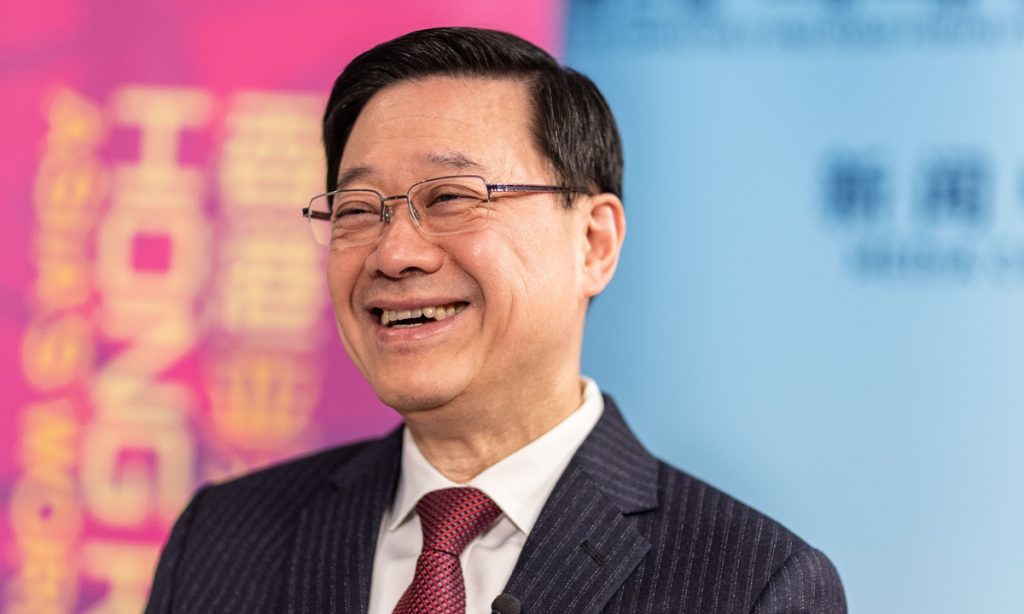
Hong Kong Special Administrative Region (HKSAR) Chief Executive, John Lee Ka-chiu (Lee), led a high-level delegation of 70 people to participate in the third Belt and Road Forum for International Cooperation held in Beijing from October 18 to 19. At the forum, he invited entrepreneurs to Hong Kong to set up belt and road offices. After the forum, he sat down with the Global Times (GT) reporters Xie Wenting and Bai Yunyi for an exclusive interview, sharing his insights on Hong Kong's role in the BRI and Hong Kong's strengths on the global stage. Lee also touched on the "competitive role" of the Hong Kong-Singapore relationship, noting that as long as the "pie" of development is made big enough, everyone can also get a larger share.

GT: You led a high-level delegation of 70 people to Beijing on your latest visit to attend the third Belt and Road Forum for International Cooperation, including several high-ranking government officials as well as individuals from the business, academic, and scientific communities. What was the consideration behind this? What is Hong Kong's role in the Belt and Road Initiative (BRI)?

Lee: I hope to use this platform of the forum to better promote Hong Kong and seek business opportunities. Many of our delegates have also established personal connections with entrepreneurs from various regions, giving them the opportunity to personally introduce Hong Kong's advantages and services, which will be more persuasive.

Hong Kong is a participant, promoter, and beneficiary of the BRI. In the joint construction of the BRI, Hong Kong has its own unique advantages. We boast the position of "eight centers," namely, an international financial center, an international trade center, an international shipping center, and an Asia-Pacific international legal and dispute resolution service center, as well as four emerging centers: An international innovation and technology center, a Chinese and foreign cultural and art exchange center, an international aviation hub, and a regional intellectual property trading center. I believe that Hong Kong can play its role in promoting financial connectivity, attracting international investment, and promoting the internationalization of the Chinese currency renminbi (RMB).

GT: We noticed that not long ago you visited three Southeast Asian countries: Singapore, Malaysia, and Indonesia. How do you evaluate the prospects for cooperation between Hong Kong and Southeast Asian countries under the framework of the BRI? Which are the areas that hold the greatest potential? In the past, people have often said that Hong Kong is a "bridge" between the East and the West. In the future, do you think Hong Kong will play a similar role between the Chinese mainland and Southeast Asia?

Lee: Hong Kong has a unique status granted by the central government and the One Country, Two Systems policy is implemented in the city. As one of the few cities in the world that can concentrate both China's advantages and international advantages, we are very lucky, and should therefore make good use of this advantage.

First, Hong Kong can help enterprises in the Chinese mainland go global, including in terms of financing, introducing talents, and scientific and technological cooperation. We can give full play to Hong Kong's functions as an international city. This is the "capital" we have accumulated over the years.

Second, Hong Kong attaches great importance to regional cooperation and hopes to have good relations with our neighbors. The ASEAN is Hong Kong's second-largest trading partner, after the Chinese mainland. This is why one of my two official trips this year was to the three ASEAN members, and I will also take time to visit other states.

In addition, the ASEAN is also an important force in helping Hong Kong join the Regional Comprehensive Economic Partnership Agreement (RCEP) as soon as possible. I am very happy that when communicating with ASEAN states this time, many of them expressed their support for Hong Kong's joining of the RCEP. In the future, we will continue to promote regional cooperation with the ASEAN.

GT: Many people view Singapore as Hong Kong's "competitor" and believe that Singapore has the potential to replace Hong Kong as Asia's international financial center. What's your opinion on this view? Will Hong Kong be replaced by Singapore? Are Hong Kong and Singapore in competition, or do they have more room for complementarity and cooperation?

Lee: Hong Kong and many places have dual competitive and cooperative relationship. Competition is a good thing. Only with competition can we make progress. Healthy competition is beneficial. In fact, I have a very good relationship with Singapore's leadership. We often discuss how there is a lot of room for cooperation and development.

I think the most important thing (for a city) is to compete with itself. Competing with competitors is important, but it is likely that one day you will have surpassed your competitors. Will you not have goals then? So, every day we have to be the object of our own competition, to surpass what we accomplished the day before, and apply this philosophy to the future as an effective long-term goal.

Therefore, I often tell my colleagues that Hong Kong needs to compete and cooperate with other regions, taking advantage of their strengths and compensating for their weaknesses. This is beneficial for our own development. Cooperation between Hong Kong and all countries and regions is aimed at mutual benefit and win-win outcomes. 

Relationships that only benefit one side are not sustainable. Maybe this time you gain more and I gain less, but next time I gain more and you gain less, and that's good.

In the end, what is the most important goal of competition? Is it the development of the economy or improving the lives of the people? As long as the "pie" of development is made big enough, everyone can also get a larger share. This is our ultimate goal.

GT: Some international media outlets have claimed that Hong Kong's international status and international attractiveness have declined in recent years. How do you respond to this claim?

Lee: Hong Kong is attractive in many aspects. In world rankings, Hong Kong holds many top positions: Our investment environment is ranked first globally, our offshore RMB trading volume is the highest in the world, and we are also the world's longest-living city. Hong Kong's public transportation system is ranked first among over 60 advanced cities, and we are the only city with an area of only 1,100 square kilometers that has five "Top 100" universities. Hong Kong also ranks second in many indicators worldwide: economic freedom, government efficiency, and innovation environment are all ranked second globally. Hong Kong has many aspects that other regions in the world envy.

The epidemic in the last few years has indeed slowed down Hong Kong's development in some areas. Some places in the world relaxed epidemic control measures relatively early, and therefore have a time advantage, but I think this advantage (relative to Hong Kong) is only temporary. Since resuming customs clearance, Hong Kong has fully integrated with the world. We are also "catching up with time" in different fields. Now, the work of the HKSAR government is all results-oriented, and many citizens also believe that many things are progressing faster this year than before. I think these are all positive factors for Hong Kong (in terms of international attractiveness).

GT: This year alone, you have visited many places in the Chinese mainland, from Beijing to Guangzhou, Shenzhen to Hainan, and Chongqing to Guizhou, among others… As the head of HKSAR, why do you visit the mainland so frequently? During these trips, what made a particularly profound impact on you?

Lee: I visited different places (in the mainland) to gain understanding. In fact, the main reason was I felt it imperative to do. Hong Kong's biggest opportunity lies in the country's development. It is most beneficial to Hong Kong to fully and proactively integrate into the overall development of the country.

At the end of 2022, I established the Steering Group on Integration into National Development to strengthen the integration of the entire HKSAR government and the entire society into the overall national development. This means that we need to develop close relations with different provinces and cities to work together for mutual benefit and win-win results. I attach great importance to this aspect and will continue to establish cooperative relationships (between them and Hong Kong) in different places.

Hong Kong now has different cooperation mechanisms and systems with many provinces and cities. I also often share my ideas with the leaders of various places in the mainland, that is, our cooperation must be "one plus one equals two." Hong Kong will put its best foot forward and so will our partners. This is "invincible."

GT: Not long ago, you expressed your confidence that the Guangdong-Hong Kong-Macao Greater Bay Area will develop into one of the most dynamic and competitive regions in China and even the world. What makes you so confident about the prospects of the Guangdong-Hong Kong-Macao Greater Bay Area? The idea of the Greater Bay Area has been proposed for many years. Do you think the construction of the Greater Bay Area will usher in some big breakthroughs in the next year or two?

Lee: I believe that the Greater Bay Area is one of the most promising regions for development in the country. Currently, Hong Kong and Shenzhen have already achieved a high level of integration, and have formed strong cooperation ties with the entire Guangdong Province. With nine cities and two special administrative regions, each with its own advantages, it is no longer just a case of "one plus on," but rather the synergy of all 11 entities working together, resulting in significant collaborative efficiency.

Hong Kong has a lot to contribute to the Greater Bay Area and the country. First, there is a wealth of talent in Hong Kong. The city is able to attract international talents, with its highly internationalized universities that are among the top in the world. 

Additionally, there are scholarships and exchange programs available, such as the "Belt and Road Scholarship," further enhancing the internationalization of Hong Kong's talent pool. Hong Kong's professionals in fields such as accounting and engineering are also highly aligned with international standards.

Second, Hong Kong has a strong advantage in scientific research. In the current complex global (geopolitical) environment, many researchers who had previously left Hong Kong or the Chinese mainland are now looking to return and conduct research in Hong Kong.

Third, Hong Kong implements the common law system, which is similar to the legal systems of many developed countries. As a result, these countries are more familiar with and trust Hong Kong's legal system. This can attract more international partners for cooperation and also make Hong Kong a preferred arbitration venue for international trade disputes.

The entire Greater Bay Area has a population of 86 million and its GDP is equivalent to the 10th largest economy in the world. It is larger than many countries, so the Greater Bay Area can compete strongly with other countries as a whole. 

I feel very happy and proud that Hong Kong has the opportunity to contribute to the development of the Greater Bay Area, and Hong Kong will also benefit greatly from it, injecting strong momentum into its own economic development.

China’s economy is far outgrowing all the others, defying US' falsifications

Data for all major economies for the second quarter of 2023 is now published, making possible a systematic comparison of China's economic performance to all other major countries. This reveals two key facts. First, since the beginning of the pandemic, China has outperformed every other major economy - in most cases by huge margins. Second, the US has launched a flat-out propaganda campaign in an attempt to conceal this fact.

Therefore, two key questions need answering. First, what are the factual trends in the world economy? Second, why has the US decided to launch a systematic campaign of falsification? 

China's growth compared to other major economies

Starting with the facts, covering the period of the pandemic and its aftermath, in the last four years, up to the latest available data for the second quarter of 2023, China's economy grew by a total of 19.2 percent. Among the major advanced economies, the G7, US growth was 7.5 percent, and Canada's was 4.7 percent. Italy's growth was 1.5 percent, France's 1.3 percent, Japan's 0.8 percent, Germany's 0.5 percent and the UK's 0.3 percent. 

China's economy grew more than two and a half times as fast as the US', four times as fast as Canada's, 13 times as fast as Italy's, 15 times as fast as France's, 24 times as fast as Japan's, 38 times as fast as Germany's and 64 times as fast as the UK's economy. 

In short, China outgrew all the major advanced economies by enormous margins.

To complete the picture, as striking as the above data is, it significantly understates China's outperformance of other economies in productivity growth and living standards. To analyze these, it is necessary to consider per capita growth, ie, including population changes.

China's annual average population increase since 2019 has been only 0.1 percent, meaning it received no boost to total GDP growth from population changes. In contrast, major G7 and BRICS economies have had large population increases - from domestic increases, immigration, or both. Since 2019, Canada's annual average population increase was 1.2 percent, India's 0.8 percent, and the US' 0.5 percent.

China's outperformance of other major economies is therefore even greater as measured by per capita GDP growth. To take even the most rapidly growing other economies, China's 4.4 percent annual per capita GDP increase compares to 2.5 percent in India and 1.3 percent in the US. India's per capita GDP growth was only 56 percent of China's and China's per capita GDP grew more than three times as fast as that of the US.

Per capita data therefore demonstrates even more strongly China's great outperformance of any other major economy - not only in terms of total growth but also in productivity and ability to increase its citizens' wellbeing.

As the facts show China outperforms every other major economy, not by small amounts but by huge margins, any objective discussion of the international economic situation would discuss questions such as "Why is China's economy growing so much faster than all the other major economies?" 

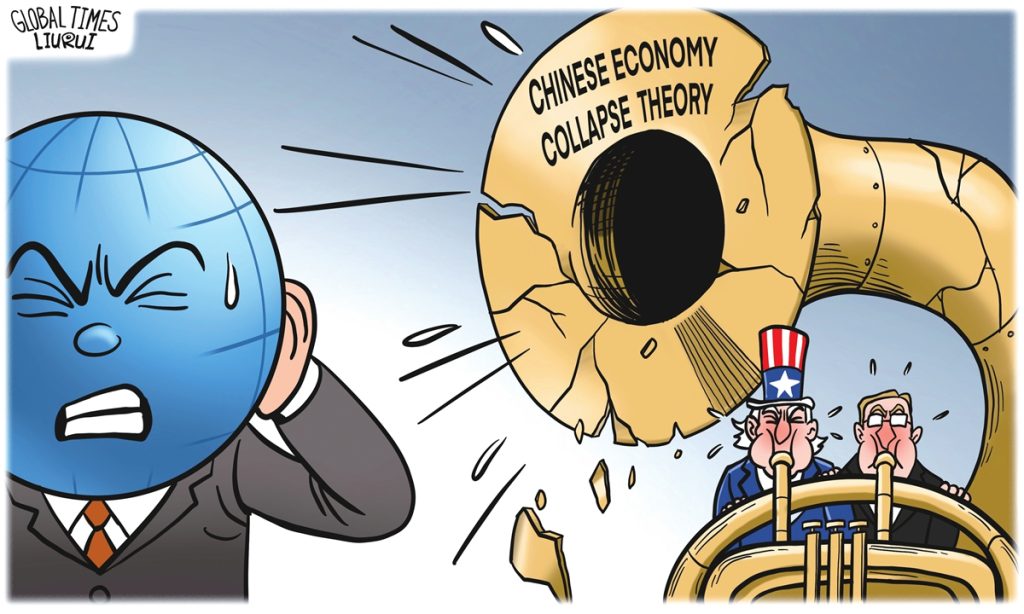
However, for the US to admit the facts of the global economy is impossible. This would be to acknowledge that it is being vastly outperformed by another economy, even worse demonstrating the superiority of socialism to capitalism. Therefore, the US has launched a systematic campaign denying reality and facts.

At the top of the US political pyramid, lack of contact with reality has now reached a bizarre level. President Biden, for example, recently claimed that China's economic growth is "around 2 percent" when it was 5.5 percent in the first half of this year. He stated that in China "the number of people who are of retirement age is larger than the number of people of working age," which is completely false. This figure which he has claimed to be true is off by hundreds of millions. He claimed that China's economy is a "ticking time bomb" - when it is the US, not China which this year suffered two of the three biggest bank collapses in its history.

The US campaign of economic 'fake news'

Alongside declarations by political figures, US media such as the New York Times, are running articles with titles such as "How do we Manage China's Decline?" - in a situation where China's economy is growing two and a half times as fast as the US and China's per capita GDP is growing three times as fast as the US!

The method of totally ignoring facts and reality is classically known as the "big lie" - the "big lie" being an accurate description of the methods used by Goebbels, even though he did not invent the phrase. This calculates that if a lie is repeatedly stated by powerful media or state apparatuses then, despite the fact it is a lie, large numbers of people may come to believe it is true simply due to the number of times it is repeated and the number of media outlets in which it appears.

What are the aims of the US in spreading these lies? Some are obvious - to try to discourage foreign companies from investing in China and try to spread demoralizing rumors. But there is another more profound and dangerous purpose.

Facts make clear China's economy is far outperforming the US. At the 20th CPC National Congress, the goal was set as reaching the level of a "medium-developed country by 2035." In 2020's discussion around the 14th Five Year Plan, it was concluded that by 2035 for China: "It is completely possible to double the total or per capita income."

In contrast, the long-term average annual US growth is only two percent. These relative growth rates mean that by 2035 China's economy would increase in size by 100 percent and the US by only 35 percent. As the US sees international relations as a zero-sum game, in which its goal is to retain its dominance, such relative growth rates are regarded as a disaster. The US sees it as crucial to slow down China and prevent it from achieving its 2035 goals.

The data already given makes clear how this could be achieved. The much slower growth of the economies of the West compared to China means that if China could be moved to a Western capitalist model, with a far higher percentage of consumption in GDP, then China's economy would grow no faster than any other Western economy. As increases in consumption and living standards are extremely closely related to economic growth, if China's economy could be slowed in that way, then China's living standards would also be lower than its targets.

But for the US to openly present an argument that "China should slow to the growth rate of a Western economy" is impossible - no one would take such a damaging proposal seriously. So, instead, the US must attempt to conceal the real situation - to make the fraudulent claim China is growing more slowly than Western economies. If that lie could be believed, then an argument could be presented that China should move toward a Western model - so that its economy could supposedly grow more rapidly. To give credibility to that claim, however, the lie must first be believed that the Western economies are outgrowing China. That is why false information must be spread.

Consequently, the reality that China is far outperforming the Western economies, while entirely true must not lead to complacency. The US is attempting to damage China via the international campaign of falsifications already outlined. The slow growth of Western economies itself creates problems for China - a negative international economic situation means China must rely entirely on increasing domestic demand to achieve its 2035 goals. To this latter well-known issue, the present author would add some others. In particular close attention must be paid to increasing profits - which are no higher than five years ago.

But to accurately address these real issues in China's economic development, first the facts must be established - that China's economy is far outgrowing all the others.

Asia trip doesn’t help Biden escape low domestic approval ratings

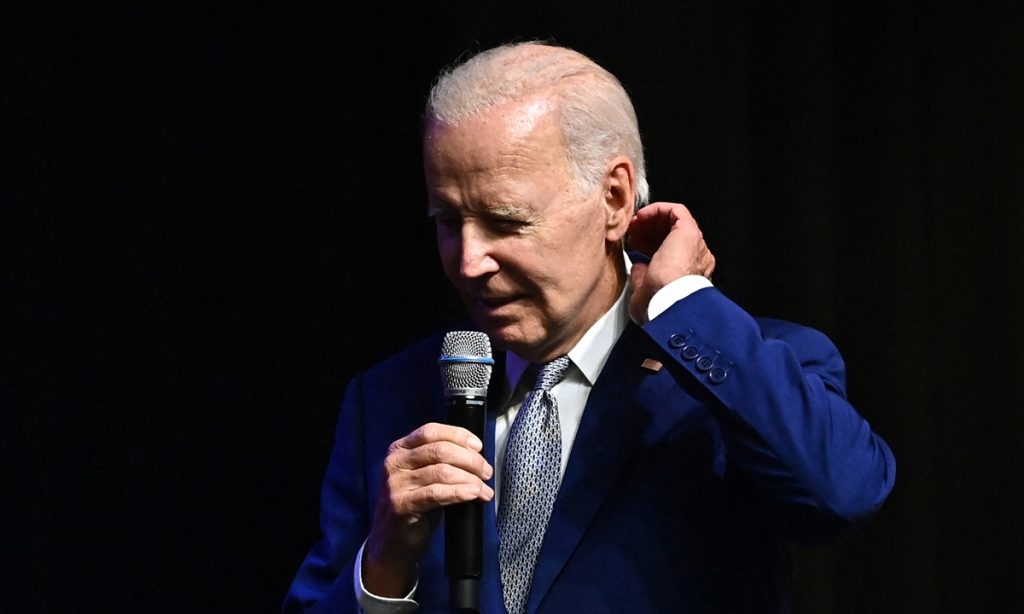
 US President Joe Biden said on Monday that the diplomatic sprint through Vietnam and India has "strengthened America's leadership on the global stage." However, it doesn't seem to be welcomed by the American public.

Biden's trip may "ultimately do little to alter his political fortunes back home, where his polling numbers are low" and there might be "a tight race against his predecessor, Donald J. Trump," according to The New York Times on Monday.

Some Senate Democrats even said President Biden's moribund poll numbers are "concerning" and "frustrating," and they are doubtful whether "the White House will change how voters view him before the 2024 election."

While there is still time before the climax of the election, Biden's Asia trip has contributed little to helping him win favor within the US. What the president faces back home is a low approval rating and a host of domestic challenges.

Foreign diplomacy doesn't concern the majority of American voters, nor is it a determinant in the general election, unless there is a major diplomatic crisis linked to domestic issues. Meanwhile, problems of real concern to the American public, such as gun violence, ethnic tensions and government shutdowns, have been left hanging.

Sun Chenghao, a fellow and head of US-EU program at Center for International Security and Strategy in Tsinghua University, believes that "it may be too early to judge the direct impact Biden's diplomatic moves may have on the election or his approval rate."

Nevertheless, the current US foreign diplomacy now seems to completely serve its internal policy. The complex situation of US domestic politics and a variety of challenges have scorched the Biden administration, forcing the president to transfer the pressure through external means, for example, creating geopolitical tensions or diplomatic results, to enhance domestic approval. In this way, foreign relations have become a tool for US politicians in partisan struggle. 

When it comes to Biden's rival, Sun added that while Trump has received great attention, it's the group of voters in the middle that will ultimately decide the winner. If this group of people chooses Biden, it may not because they support him, but rather because they cannot accept Trump.

Wang Yiwei, director of the Institute of International Affairs at the Renmin University of China, added that "Biden is now trying to prevent Trump from coming to power by taking advantage of people's concerns over Trump, and next year there will be more heated insults. In this way, the internal contradictions in the US will be further radicalized."

At the same time, China-US relations are always a critical issue for both parties in US election. In this regard, Biden has inherited many of Trump's policies toward China, and even further escalated the containment of China, especially in terms of technology blockade.

Although the Biden administration's policy toward China has recently shown a positive signal, the overall tune remains containment. Biden now insists he's not trying to "contain" China, but the high wall is only being built more solid. Taking the defeat of China as the top priority and campaign card will only cause the US to ignore its own internal problems and challenges, waste resources and time, and be plunged into unnecessary confrontation. 

The US electoral politics itself has a string of drawbacks since its birth. Under this political election system, a policy may only last for four years, and bipartisan politics will bring about instability in national policy, be it the China policy, or other foreign policies. As a result, other countries will lower the expectations of the US policy.

Over time, the system has deviated from its original design to some extent, including the details of some rules in election, but it is difficult to carry out an overall reform, which has led to the disordered money-oriented politics in the US election.

The ills of unscrupulous American electoral politics is already a cliché, but they seem to be even more troublesome. Against the backdrop of the US exacerbating geopolitical contradictions, the world will pay for the failures of the American political system and party campaign. This will not only fail to resolve America's own problems, but will also backfire and drag the world into the mire. Therefore, no matter who is elected, we hope that the US will put aside its selfish self-interest and zero-sum mentality, stop the "internalization" of foreign diplomacy, and seek for a win-win future.

Blinken sounds a rallying cry for a ‘new cold war’ that US cannot win

The growing US' geopolitical competition with Russia and China marks the end of the post-Cold War world order, US Secretary of State Antony Blinken said, speaking at the Johns Hopkins University's School of Advanced International Studies on Wednesday. "What we are experiencing now is more than a test of the post-Cold War order. It's the end of it," he noted. "Decades of relative geopolitical stability have given way to an intensifying competition with authoritarian powers, revisionist powers." This statement appears to be a rallying cry for a "new cold war." 

Since the post-Cold War order is coming to an end, what kind of new world order does the US want? Various signs indicate that the US wants major power competition and camp confrontation in order to maintain its global hegemony, even at the expense of the interests of other countries, including allies, and partner nations. However, the reality is that major power competition goes against the trend of the times and cannot solve the US' own problems and the challenges facing the world. It will only further divide the world, leading the world to slide toward a more dangerous cliff edge.

Regarding Blinken's remarks, there are two main points to consider. Firstly, Blinken was creating a sense of crisis in the world. The underlying message to US allies and other countries is that there are challengers, particularly China and Russia, who want to change the existing order. Secondly, Blinken's remarks also reflect a sense of anxiety in the US. The US is attempting to slow down China's rise through strategic competition, while hoping to sustain its hegemony without jeopardizing its own interests. However, it seems that the US has no clear solution to this dilemma. 

China is one of the beneficiaries of the existing system and does not seek to challenge or subvert this order. However, the US has viewed any legitimate demand made by China, even those that reflect the reasonable demands of the majority of developing countries, as a challenge and ill-intentioned sabotage. 

Xin Qiang, deputy director of the American Studies Center of Fudan University, believes that US irrational crackdown on China will only irritate China and other developing countries. Many developing countries share common demands with China, but the US opposes whatever China proposes and intends to strangle its legitimate right for development. This will ultimately lead to the destruction of the existing international order and be counterproductive to the US' goals.

The US believes that by containing China, it will gain an advantage. However, whatever damage they're doing to China, it also backfires on the US and even the world. 

The US now sees China as a competitor and challenger, opposing and obstructing anything that may benefit China, regardless of its impact on the US. This approach not only fails to maintain US hegemony but also leads it further away from the right direction. 

Today, the US is embroiled in simultaneous confrontations with China and Russia. The US needs to think carefully, as it will be more difficult to engage in a "new cold war" compared to the previous one. In the 1970s, the US GDP accounted for nearly one-third of the global total, but now it is only one-fourth. Its two major opponents are the nuclear power Russia and the economic powerhouse China. In order to defeat Russia, the US must ultimately dismantle its nuclear deterrence, which would be a thrilling adventure. 

As for China, the US is attempting to stifle its development by imposing unlimited technological restrictions, but it is unable to completely decouple from China economically. For the US and its main allies, China is either their largest single trading partner or one of the largest. Today, the US is a reckless strategic aggressor, attempting to unite its relatively weaker strength with its allies to wage a new cold war. It should be noted that the power of US allies has declined significantly, and the unity of the "West" is crippled due to the US transitioning from a "blood donor" to a "vampire".

The current generation of American elites arrogantly seeks to replicate the victory of the Cold War, but they will never succeed. Instead, the US will face a different ending.

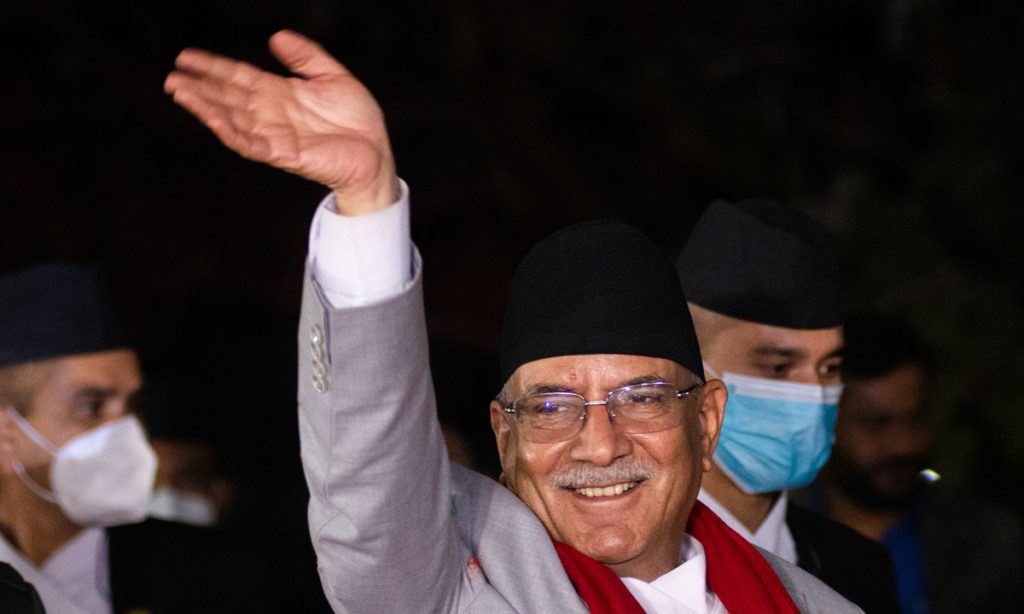
Prachanda’s China visit highly anticipated as Nepal seeks ties of equi-proximity with both China, India

Nepali Prime Minister Pushpa Kamal Dahal will be on an official visit to China from September 23 to 30, during which he will attend the opening ceremony of the 19th Asian Games in Hangzhou, and meet President Xi Jinping as well as several other leaders. Dahal believes the visit will strengthen and deepen the traditional friendly relations between China and Nepal. Another aim of the visit is to seek further avenues of bilateral cooperation.

On September 7, the first batch of imported goods under the China-Nepal Transit Transport Agreement, consisting of 15 tons of turmeric powder, arrived in the Nepali capital of Kathmandu after transiting through China. The turmeric powder was imported by Nepal from Vietnam and transported to Kathmandu via Tianjin Port in northern China and the Zhangmu-Tatopani border point. Both China and Nepal have positively commented on this achievement. The Nepali side stated that the successful transportation of the first batch of goods under the China-Nepal Transit Transport Agreement signifies the beginning of a transformative journey toward enhanced economic cooperation, increased trade volumes and shared prosperity. Chinese Ambassador to Nepal Chen Song noted that the successful implementation of the China-Nepal Transit Transport Agreement will diversify Nepal's international trade and facilitate Nepal's trade with the whole world. In the future, the time and cost of importing and exporting goods via China will be further reduced, which will have a positive impact on Nepal's trade.

In contrast to the substantial progress made by China and Nepal in areas such as cross-border transportation, Nepal has been facing ongoing issues with another neighboring country, India, recently. In May, the Nepali government was infuriated by a mural displayed within the newly inaugurated Indian Parliament building. This mural, titled "Akhand Bharat," included the Chinese Tibet region, parts of Afghanistan, as well as the entire territories of Nepal, Pakistan, Bangladesh, Sri Lanka and Myanmar. As early as May 2020, India inaugurated a road connecting the Indian mainland to the border region, passing through the disputed territory of Kalapani, which is claimed by Nepal.

In fact, the incidents of the mural and road inauguration reflect the ongoing contestation and counter-control between Nepal and India, which has been a longstanding feature of their relationship. For a long time, India has adopted a paternalistic approach in its policies toward Nepal. While providing some support and assistance, India often resorts to rude and unilateral actions toward Nepal.

Nepal is located north of the Himalayas and is surrounded by Indian territory in the west, south and east. It heavily relies on India for economic and external communication, including the transit of essential goods such as food, medicine and fuel through India. India is Nepal's largest trading partner. In addition to the geographical dependence on India for external connectivity, Nepal is also deeply influenced, and even controlled, by India in political, social and security domains.

However, this has become a bargaining chip for India's attempt to control Nepal. In history, India has repeatedly used the agreement on transit through Nepal as a coercive diplomatic tool, threatening and implementing blockades against Nepal to force the Nepali authorities to adopt domestic and foreign policies that align with India's wishes. This has caused serious dissatisfaction among various levels of Nepali society and the government. Nepal has also actively sought alternative transportation routes to reduce its dependence on India. In 2017, Nepal officially joined the Belt and Road Initiative, which was a clear indication to India that Nepal is a country with the right to make independent choices.

Objective conditions determine that Nepal will continue to rely to varying degrees on the transit routes provided by India in the past, present and future, which means that Nepal cannot completely sever ties with India. In this situation, how to handle relations with India without compromising national sovereignty, independence and territorial integrity while ensuring smooth communication between Nepal and the outside world has always been the greatest challenge for Nepal's foreign policy. It is precisely because of this, after Prachanda assumed the position of Prime Minister for the third time, he made his first visit to India. 

In contrast, China strictly adheres to the Five Principles of Peaceful Coexistence and never interferes in Nepal's internal affairs. All factions in Nepal actively seek development and close relations with China. After assuming the position of Deputy Prime Minister, Narayan Kaji Shrestha stated that the country will "maintain relationships of equi-proximity with both our neighbors," namely China and India, emphasizing that the focus of governance will be on "containing inflation, maintaining reserves, raising capital expenses, narrowing the trade deficit and lowering interest rates" to promote Nepal's economic development. The results of Prachanda's visit are highly anticipated.